Travel blog post

The meat you sleep with

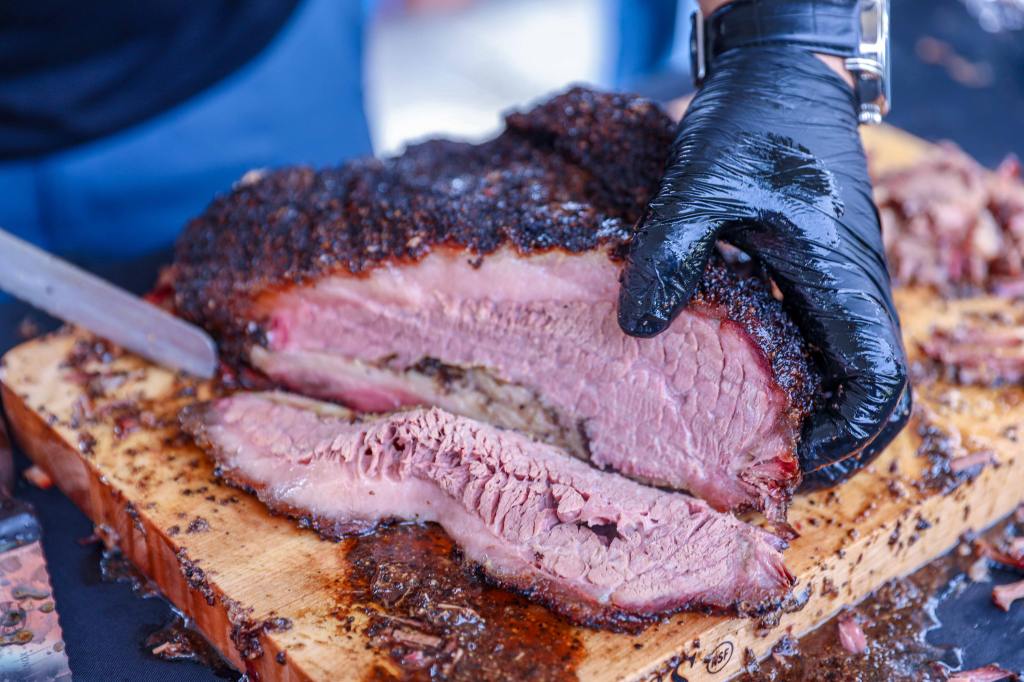
In Texas, if there is any meat you want to sleep with, it’s brisket. 

Texans take Barbeque uber seriously, committing to long shifts tending fires of burning oak, pecan, mesquite, or hickory wood for 16-24 hours. The prized meat, cooked in indirect heat, is generously covered with a heavily spiced rub while the magic of heat and meat takes a normally tough piece of beef breast and transforms it into a tender, juicy taste delight. Don’t ask for sauce because, in Central Texas, it may offend the cook.

Like the competitiveness between Texan A&M (Aggies) and the University of Texas (Longhorns), the competition between barbeque styles defined by region is intense. East Texas boasts a slow-cooked style in a sweet tomato-based sauce, while West Texas barbeque, affectionately known as Cowboy Style, is cooked over the direct heat of burning mesquite wood. South Texas may cook their Barbeque in a molasses-thick sauce, but it’s the Central Texas style that is considered the king of barbeques; at least, that’s what residents of Elgin, Lockhart, Luling, and Taylor say. Let’s face it: Texas is no place to be a vegetarian.

Although New York may be known for its bagels, Chicago for its pizza, and San Francisco for its sourdough bread, Texas is all about burning some beef

As the barbeque season officially opened on Memorial Day, a little history is due to our celebration of the American grilling season, which closes its curtain on Labor Day. Although no one knows the culture who invented the art of Barbeque, when the Spanish arrived in the Americas (specifically in the Caribbean), they noticed the native population slow-cooked their meats over heated coals on wooden platforms. The American South quickly adopted Barbeque. It provided an excellent way to transform lower-quality meat cuts into tasty meals and keep leftovers alive longer, essentially making a silk purse out of a sow’s ear—so to speak. Former President Lyndon Baines Johnson enhanced his political career with what he called his barbeque diplomacy, taming political opponents with brisket, ribs, and down-home cooking.  

Today, Texas barbeque is a culinary delight worthy of a quest from region to region. As the summer season ramps up, we raise our forks and lick our chops for the folks sleeping with the meat.
Travel blog post

A small find in Moorpark.
 
She calls herself The Persimmon Lady. Met at the farmers market in Santa Clarita, California, on a crisp, cool Sunday morning in December. Darlene Costa nearly corners the persimmon market from October through early January when persimmons are in season.

Persimmons are not what you’d call a household fruit like apples, oranges, and bananas. Yet for those who love the sweetness and texture of this yellow-orange fruit that tastes like nectar from the gods, it does add unique flavor to baked goods and salads or can be eaten straight off the tree. In California, there are two varieties of persimmon, the Fuyu and Hachiya. The Fuyu resembles a squat yellow-orange tomato, and the Hachiya is similar to an overgrown red-orange acorn. In my opinion, Fuyu is much preferred as the Hachiya has tannins that make the mouth pucker if eaten when not ripe.

Most persimmon varieties were imported from Asia in the 18th Century, and today, California delivers the largest production in the nation. Health tip: persimmons are a good source of fiber and vitamins A, C, B6, and magnesium. Some nutritionists claim that persimmon is more vitamin-rich than apples.

More delicious than the sweet persimmon fruit is the farmer of such delights, Darlene Costa. The former flight attendant and secretary, Darlene, and her Italian-born husband took the road less traveled from conventional corporate jobs to owning a hobby farm in Moorpark, California. On their five-acre farm, they have over 150 persimmon trees of both Fuyu and Hachiya varieties, a few acres of grapes where they produce their signature wine, and a small citrus grove in the front of the house. Inside the shed hangs three legs of salted pork in the process of becoming prosciutto and a starter for homemade sourdough bread. This place is the ideal location to weather an earthquake in style.

We took the “Bob”—a small all-terrain vehicle—down the hill to the orchard. After the first frost of the year, the trees had shed their leaves, and all that remained were clusters of Fuyu persimmons strewn on branches like ornaments on a Christmas tree. It looked like easy picking, and if you like persimmons, it was a slice of paradise on the branch.

Moorpark might not be prominently featured as a travel destination in Southern California, even though it achieved a level of recognition in 2005 with the unearthing of an ancient mammoth skeleton. Presumably named after the Moorpark apricot, the town of Moorpark is an unexpected find for persimmons and a delightfully distinctive orchard farmer often seen at local farmer’s market. 

Travel blog post

Yah, rah, air conditioning!

Ah, summer in Phoenix! The temperatures are hitting 110°, and the scorching heat outside feels like stepping into an oven, sapping every last drop of moisture from my body. But fear not, for the car air conditioner comes to the rescue with its refreshing blast of cold air, almost giving me a brain freeze!

As the mercury rises above 100° every day of Summer, I can’t help but thank the stars for the ingenious invention of air conditioning. I bow my head in homage to the genius behind it all, Willis Haviland Carrier, who operated the first modern electric air conditioning machine in 1902.

It’s fascinating to learn that the term “air-conditioning” was coined by Stuart M. Cramer in 1906 while exploring evaporative cooling for textile processing. And who could forget the revolutionary development of Freon gas in 1928, making air conditioning a common standard of living with refrigerators and cooling systems?

As the scorching heat would make travel unbearable in the desert, I’m grateful that Hewlett Packard Motor Company took the leap in 1935 and installed automobile air conditioning. Today, traveling comfortably is easy, even during the hottest days.

Air conditioning revolutionized how we live and where we choose to live. It’s amazing how practical needs have given rise to such incredible innovations.